- Bharatiya Janata Party
-

By Sushil Bhati
- 13 May, 2026
In a democracy, the true strength of governance is not measured only by policies and announcements, but by the government’s ability to listen to its people, understand their struggles, and deliver timely solutions with sensitivity and commitment. Uttar Pradesh today stands as a powerful example of such governance under the leadership of Hon’ble Prime Minister Shri Narendra Modi Ji, Hon’ble Home Minister Shri Amit Shah Ji, and Hon’ble Chief Minister Shri Yogi Adityanath Ji.
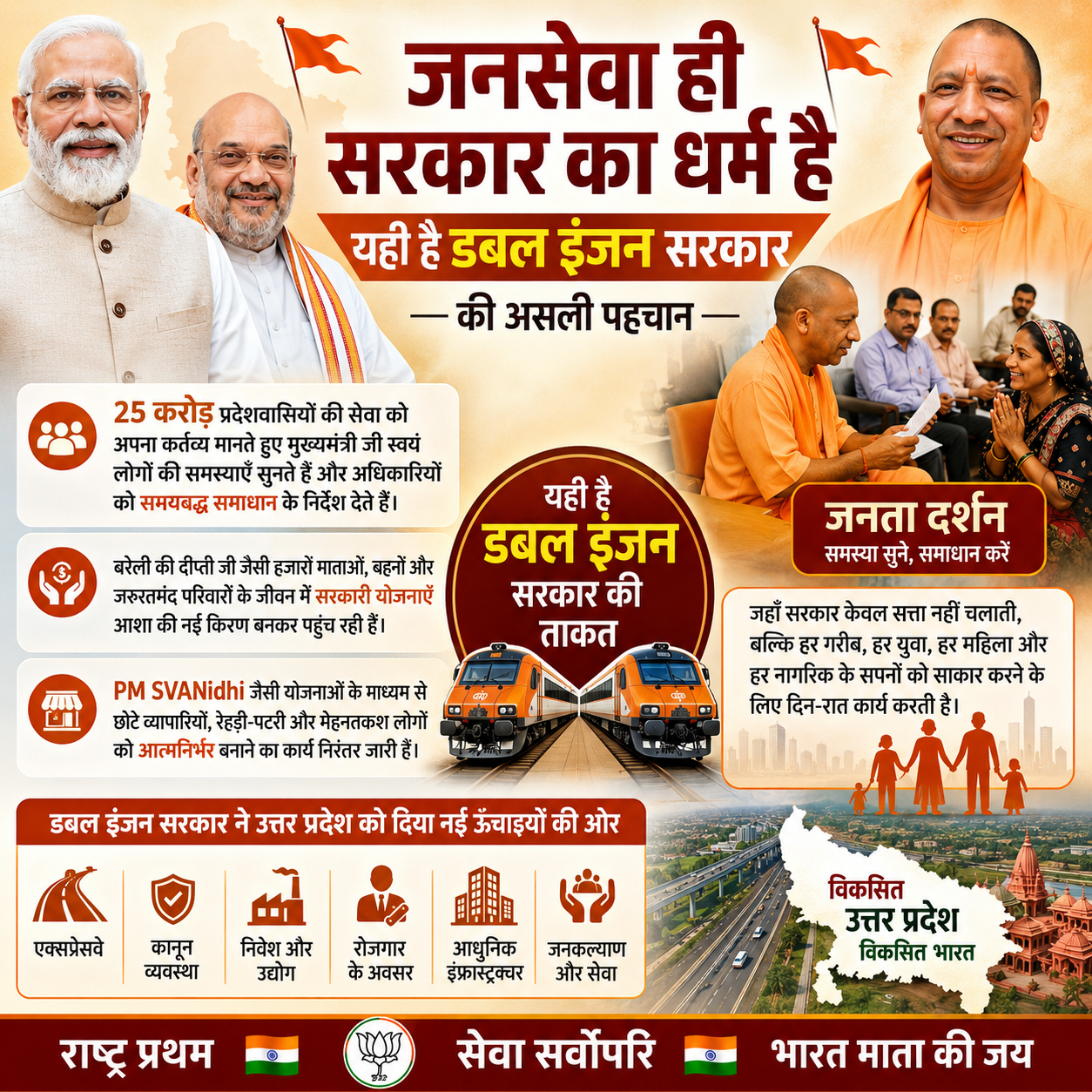
The recent Janata Darshan conducted by Chief Minister Yogi Adityanath Ji once again reflected the spirit of responsible governance and people-centric administration. It demonstrated that the Double Engine Government is not merely focused on administration from offices, but is continuously working 24x7 to resolve the problems of citizens and improve their quality of life.
During the Janata Darshan, Chief Minister Yogi Adityanath Ji personally interacted with people from different districts of Uttar Pradesh, listened to their grievances, and directed officials to ensure timely and effective solutions. His clear message that “public service is the duty of the government” reflects the commitment of the administration toward serving the 25 crore people of the state with dedication and accountability.
One of the most touching moments from the event was the interaction with Deepti, a resident of Bareilly, who shared her financial struggles while trying to raise her children through the small income earned from a handcart business. The immediate instructions given by the Chief Minister to connect her with the benefits of the PM SVANidhi Yojana and provide local assistance showcased not only administrative efficiency but also human sensitivity.
Such moments reveal the true meaning of governance — where leadership is not distant from the people, but emotionally connected with their pain, hopes, and aspirations.
The Double Engine Government model has transformed Uttar Pradesh into a state where development and welfare move together. Over the years, the state has witnessed historic growth in infrastructure, law and order, investment, employment opportunities, healthcare, education, and public welfare. Modern expressways, metro projects, industrial corridors, data centers, airports, and smart city initiatives are reshaping Uttar Pradesh into one of India’s leading growth engines.
At the same time, welfare schemes aimed at empowering the poor, women, youth, small traders, farmers, and entrepreneurs are creating opportunities at the grassroots level. Initiatives such as PM SVANidhi, PM Awas Yojana, Ayushman Bharat, Digital India, Skill Development Missions, and Startup support programs are helping millions of citizens become self-reliant and economically empowered.
The leadership of Prime Minister Narendra Modi Ji has given India a new vision of governance based on development, transparency, technology, and nationalism. Under his leadership, India has emerged as a stronger, more confident, and globally respected nation. His vision of “Sabka Saath, Sabka Vikas, Sabka Vishwas” continues to inspire governance models across the country.
Hon’ble Home Minister Amit Shah Ji has played a vital role in strengthening governance systems, national security, and organizational discipline. His strategic leadership has contributed significantly toward creating a stable environment for rapid development and social progress.
Meanwhile, Chief Minister Yogi Adityanath Ji has transformed Uttar Pradesh through decisive leadership, strict law enforcement, infrastructure development, and efficient administration. His commitment toward public welfare and direct engagement with citizens through initiatives like Janata Darshan reflects a governance model based on accessibility, accountability, and action.
Today, Uttar Pradesh is no longer seen through the lens of backwardness or instability. Instead, it is emerging as a symbol of growth, investment, industrial expansion, technological progress, and public trust. The state’s transformation is visible not only in statistics but also in the confidence and optimism of its people.
The spirit behind the Double Engine Government lies in continuous service. It is a governance approach where every scheme, every project, and every policy is designed to improve the lives of ordinary citizens. Whether it is helping small street vendors become financially stable, providing better roads and infrastructure, ensuring law and order, creating employment opportunities for youth, or empowering women through welfare programs — the focus remains centered on people.
Such governance also inspires social workers, public representatives, and dedicated citizens to contribute actively toward nation-building and social welfare. When leadership at the highest level works with honesty and commitment, it motivates society to participate in the collective journey of development and service.
The Janata Darshan is therefore not just a public interaction program; it is a symbol of responsive governance and democratic responsibility. It reflects a system where the voice of every citizen matters and where administration is expected to deliver results with compassion and urgency.
As India moves toward the vision of a “Viksit Bharat,” Uttar Pradesh is playing a crucial role in driving growth, innovation, infrastructure, and social progress. The state’s journey under the Double Engine Government proves that when leadership, policy, and public welfare work together, transformation becomes inevitable.
Public service is indeed the true duty of governance — and Uttar Pradesh today is witnessing that commitment in action every single day.
🇮🇳 Nation First | Service Above Self
🇮🇳 Bharat Mata Ki Jai | Jai Hind
Share:
Sushil Bhati
Sushil Bhati is a distinguished figure known for his profound contributions to Indian politics, legal advocacy, and social welfare. As a dedicated member of the Bharatiya Janata Party (BJP), he has exemplified steadfast leadership and unwavering commitment to the nation's development and the well-being of its people.
Write to Me
Fill out the form and we will connect with you.